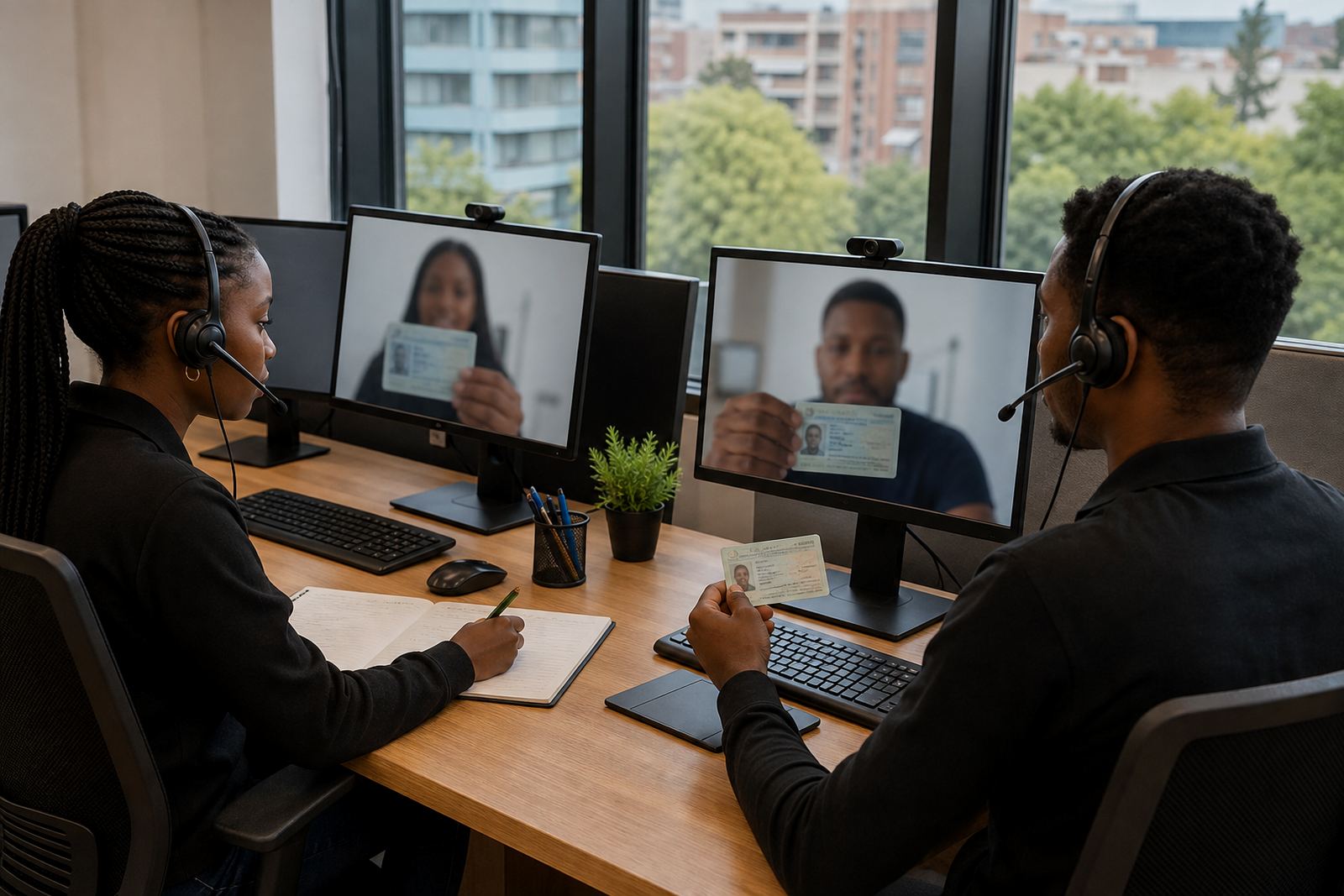
Language support that fits a live verification flow
Multilingual agent support sits inside the verification journey, not around it. The agent keeps the session moving while the customer shows an ID document, faces the camera and follows the prompts needed for identity matching. That can include English, Afrikaans and commonly used South African language needs, depending on the client brief and the customer base they serve.
This service is a good fit for finance teams, onboarding desks, account opening teams and verification operations dealing with customers from Johannesburg, Pretoria, Cape Town, Durban and Gqeberha. It is also useful where clients operate nationally and the support team must manage accents, mixed language usage and short instructions without losing control of the process.
The point is not translation for its own sake. It is making the session easier to follow so the customer can stay engaged, the agent can keep the evidence clear and the record keeps its value for internal due diligence.
Support layers and session sizes
Support can be arranged in different depths depending on your workflow and the volume of sessions. Some clients need live bilingual prompting only, while others want a broader operating layer that includes script wording, escalation notes and staff coaching. We map the support level to the way your verification team already works.
- Single-language support for one main customer group, with consistent scripted prompts.
- Dual-language support for mixed customer bases where session pacing matters.
- Multi-language call flow support for larger onboarding teams across several provinces.
- Agent script design for greeting lines, consent prompts and ID capture steps.
- Escalation wording for unclear images, poor lighting or mismatch concerns.
For smaller teams, a narrow support setup may be enough. Larger teams often need layered guidance, where one agent handles the live interaction and another process owner watches the quality and record keeping. The service can also be paired with refresh training when scripts change or staff turnover alters the way sessions are run.
Where multilingual support earns its place
This product works best where onboarding depends on customer comfort and clear instruction. A short video session can stall if the customer does not understand what to hold up, where to look or when to pause. Language support reduces that friction and helps the team keep the identity check orderly.
It is a practical fit for:
- Retail finance onboarding with customer sign-up done remotely.
- Insurance and credit account opening where the customer must be guided through document capture.
- Utilities and service providers verifying account holders before activation or profile changes.
- Any operation using remote customer due diligence and record keeping in line with internal control needs.
In Rosebank and the wider Johannesburg area, many teams want a blended model where central operations handle the policy side and multilingual agents manage the live session. That structure also works well for distributed teams serving clients in Sandton, Midrand and other metro nodes.
Fit-out for remote sessions and agent stations
Multilingual agent support does not need heavy physical fitting, but the working setup still matters. Agents need a stable internet connection, a clear camera, a headset that keeps speech clean and a quiet session area with enough privacy for personal information. The screen layout should keep the ID capture, notes and escalation prompts easy to read.
Where the service forms part of a broader verification room, the station plan usually includes a monitor at about 24 to 27 inches, a headset with noise control, a backup power plan for the workstation and enough counter space for scripts, check sheets and incident notes. Teams that run a shared queue often prefer more than one station so a busy intake period does not push the flow off balance.
Installation help can include layout planning, test sessions, API coordination, agent script design and go live stabilising. If a client already has an internal verification tool, we work around the existing setup and adapt the agent support to the current process rather than forcing a new one.
What the team keeps checking during live work
Good multilingual support is not only about speaking the right language. The agent still has to watch the document image, the face match and the live behaviour around liveness prompts. Clear speech, steady pacing and accurate notes matter just as much as the wording itself.
- ID document capture is complete and readable.
- The face on the screen matches the document photo.
- The customer follows the live prompt without confusion.
- Consent wording is captured and recorded in the right place.
- Any mismatch, blur or interruption is escalated in line with the workflow.
In a South African environment, that consistency matters because customers may switch languages mid-sentence or use a home language to confirm a detail before returning to English. The agent needs enough skill to keep the session calm while the record remains usable for customer due diligence and internal audit trails.
Care, refreshes and operational upkeep
This service needs regular upkeep, not one-off setup only. Scripts age quickly when a business adds new products, changes onboarding fields or adjusts escalation rules. Refresh training keeps the team aligned and prevents small language gaps from becoming repeated handling errors.
We usually recommend routine quality monitoring, note reviews and short refresh sessions when any of these change:
- Customer profile mix shifts into a new language pattern.
- Verification steps are amended in the onboarding flow.
- New staff join the live team or move into quality review work.
- Escalation points need firmer wording for unclear sessions.
Good care also means checking headset condition, camera positioning and microphone clarity. If one station records dull audio or inconsistent face framing, the language support will not be enough on its own. The toolset and the agent discipline need to work together.
Order details to confirm for a clean brief
When you are setting up multilingual agent support, the brief should name the languages required, the type of customers you onboard and the exact place the support sits in the flow. It also helps to confirm whether the agents must only prompt, or whether they must also handle escalation notes and after-session reporting.
Useful order details include the following:
- Primary and secondary languages required for live sessions.
- Expected session volume by region or branch group.
- Whether support is for live guidance, script design or both.
- The document types your customers present during verification.
- Any integration points that affect the agent screen or handover notes.
- Quality checks, record keeping rules and the preferred escalation route.
Clients across South Africa often start with a single line of support and expand once the workflow is settled. That approach suits teams in Cape Town, Durban and Gqeberha as much as it suits Johannesburg operations, because the operating details stay clearer when the language layer is planned instead of improvised.
Key facts
| Service type | Multilingual agent support for remote video identity verification |
|---|---|
| Language scope | English plus selected South African language support as required by the client brief |
| Use case | Customer onboarding, ID capture guidance, face comparison and live session control |
| Setup options | Script design, live support, escalation design, training and quality monitoring |
| Integration fit | Works with existing onboarding systems, session queues and API-linked workflows |
| Operating areas | Johannesburg, Pretoria, Cape Town, Durban, Gqeberha and national clients |