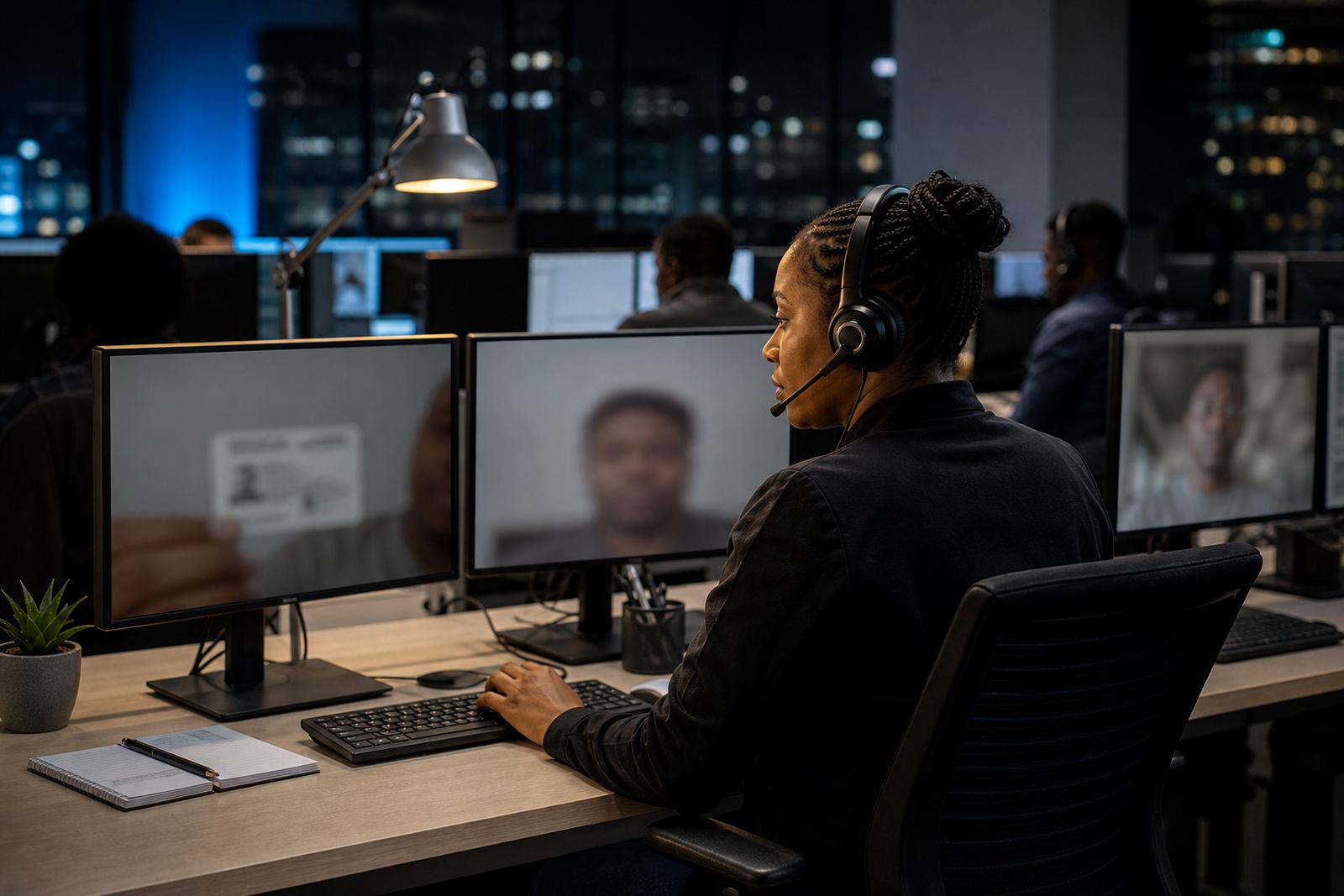
When the application lands outside office hours
After-hours operations are useful when the customer is ready to proceed, but the office team is not sitting at their screens. A guided video session can still capture the ID document, compare the face to the document photo, and record the session notes for the internal file. That matters for businesses that open accounts late in the day, or process a burst of applications after payday.
In practice, after-hours coverage is not only about longer trading hours. It is about keeping the process controlled when the usual office rhythm is quieter. The workflow still needs the same checks, the same consent steps, and the same record keeping that support customer due diligence under FICA and POPIA-friendly handling of personal information.
What a late session has to hold together
A good after-hours workflow feels calm to the customer and tidy for the operations team. The agent or verifier needs a clear script, a stable handover path, and a clear way to flag anything that needs a second look the next morning. If those pieces are loose, the session can still happen but the file becomes harder to close out.
- Identity document capture must be legible and complete.
- The face comparison should be done against the live video view and the document image.
- Liveness checks help reduce spoofing and replay risk.
- Consent needs to be captured before recording or storing session material.
- Escalations need a marked route, not a vague note in a chat thread.
That structure is useful across Johannesburg, Pretoria and Cape Town, where customers often apply after work hours and expect a process that feels orderly from start to finish.
The people side of the late shift
After-hours operations rely on more than software. Someone has to manage the queue, watch the quality of the session, and keep the customer moving without skipping steps. For a remote video identity verification service, that usually means a team lead, a trained verifier, and a clear QA path that can catch weak images or a rushed script.
At PersonVideo ID, the operational side is shaped by people like Naledi Adonis on operations, Jared Jantjies on integration work, Anele Nortje on training, Megan Vermaak on client success, Sibusiso Gamieldien on quality assurance, and Leila Petersen on verification team leadership. Thabo Mokoka leads the business from Rosebank, Johannesburg, with a base that serves clients in Sandton, Midrand and further afield. The names matter because after-hours work depends on clear ownership and not on one person carrying the whole line.
- Training should cover tone, pace and what to do when a customer is uncertain.
- Staff need a repeatable script for consent, document display and closing the session.
- Escalation design should show who reviews exceptions and how they are logged.
- Quality monitoring should look at image clarity, script discipline and decision notes.
Integration choices that keep the night shift usable
If a business wants after-hours coverage, the integration has to support it properly. That means the customer journey, the internal case file, and the verification record should move together without extra manual typing. API coordination and workflow mapping are useful here because they stop the late shift from becoming a stack of disconnected tasks.
A local lending firm in Rosebank, for example, might see a surge in applications after 6 pm from customers in Durban and Gqeberha. If the video flow is integrated into the onboarding system, the customer can enter the session, present the ID, and finish the verification step without waiting for a morning callback. The internal team then wakes to a clearer set of files, not a pile of loose screenshots and half-finished notes.
That kind of setup often needs pilot launch support, operational reporting, and change request handling once the first week has exposed where the process bends under pressure.
A Rosebank example with a wider South African footprint
Rosebank is a practical place to run the base for this kind of service because it sits close to many business clients, yet the actual verification work can reach anywhere with a stable connection. A company in Sandton may want late-day onboarding for corporate accounts, while a retailer in Pretoria may need it for higher volume consumer applications. Cape Town teams often ask for tighter script control, while Durban operations may focus on queue handling over peak evening periods.
What makes the model work is not the city itself, but the discipline behind it. The session should be short, clear and traceable. The customer should know what to show, when to pause, and what happens next in the process. Staff training and refresh training are especially useful when a client expands from daytime use into evening and weekend cover.
A late session is not a relaxed session. It is a controlled one, with enough structure to keep the record clean and enough flexibility to handle a real person on the other side of the screen.
The operating habits that keep after-hours work tidy
Once the service is running beyond typical office hours, small habits make the biggest difference. The team needs consistent naming for files, clear queue labels, and a way to distinguish completed checks from those that need review. Operational reporting also helps client managers see where the evening flow is smooth and where friction shows up.
- Keep a fixed opening script for every session.
- Use one route for document issues and another for technical issues.
- Store session notes in a format the client team can read later.
- Review edge cases during the next internal quality round.
- Update agent script design when patterns shift in the queue.
After-hours operations work best when the process is boring in the right way. The customer feels guided, the agent stays calm, and the business gets a cleaner record for later review.
When extended coverage is worth the extra structure
Not every business needs late sessions, but many do need the option. If your customers apply after work, travel across time zones, or only find time to finish forms in the evening, extended coverage can support that demand without stretching the main office routine. The point is not to keep people online for the sake of it. The point is to handle more of the intake when customers are ready.
For some clients, that means a pilot launch with a small queue and careful reporting. For others, it means staff training, escalation design and ongoing refresh training so the late shift does not drift away from the standard process. Either way, the service should feel measured and practical, with clear steps from first video contact to completed verification record.
That is where after-hours work earns its place. It gives the business a way to keep onboarding open without loosening the checks that protect the account-opening process.