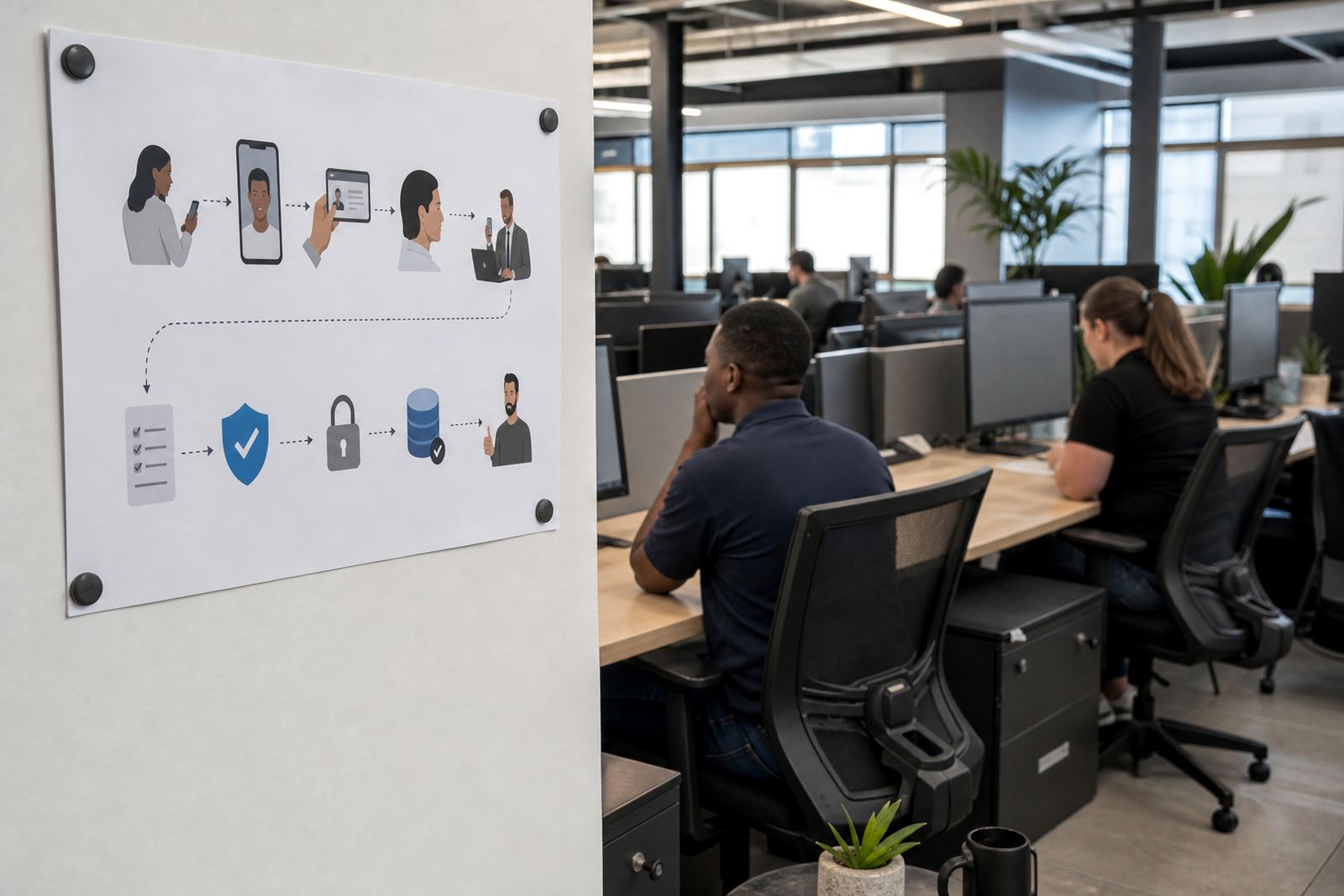
Student intake flow built around appointment slots
The client served students in Stellenbosch and needed a video identity process that fit around lecture times, residence living and weekend movement. We set up appointment slots so applicants could join at a set time, present an ID document on camera and move through a guided verification call without crowding the intake team.
The brief also called for a clear path where a parent or guardian had to be involved. We built that into the workflow early, so the operator could note the relationship, capture consent where needed and keep the session moving without making the student repeat details.
What the rollout had to hold steady
The main constraint was consistency. Student users arrive with different levels of digital confidence, different devices and patchy preparation, so the process had to stay readable from the first prompt to the final record note. We also had to keep the steps suitable for remote onboarding across South Africa, not only for the Stellenbosch branch of the project.
- Clear instructions before the session started
- ID document capture that could be checked on screen
- Face comparison and liveness checks during the call
- Guardian handling steps for minors or dependant applicants
- Record keeping aligned to consent and audit needs under POPIA
How we shaped the verification path
We worked through workflow mapping first, then turned that map into a practical agent script. The script covered greeting, consent prompts, document handling, face match checks and the points where a case needed escalation. That helped the team keep each session steady, even when an applicant arrived late or had trouble framing the document properly.
Jared handled the integration planning side, with API coordination for the client’s onboarding stack. Anele shaped the training material for the staff who would guide applicants, while Sibusiso set the quality checks for document images, call notes and exception handling. The result was a process that felt structured without sounding stiff.
- Workflow Mapping
- Integration Planning
- API Coordination
- Agent Script Design
- Escalation Design
- Quality Monitoring
Four weeks from draft flow to live sessions
The rollout took four weeks from discovery to live use. The first week focused on the intake path and the differences between adult applicants, students with guardians and cases that needed extra verification. The second week moved into script writing and system handover notes. Week three covered testing with sample journeys and exception scenarios. The final week was used for pilot launch support and operational reporting.
That sequence gave the client room to spot weak points before live volume increased. A few of the early cases showed where learners needed slower prompts or a clearer cue for holding the document under better light, and those notes were folded into the operating routine.
What the student rollout changed on the ground
Once the process was in place, the client had a cleaner way to open accounts for students without calling everyone into a physical office. Appointments reduced overlap, guardian handling steps stopped awkward backtracking and the record trail became easier to follow during internal checks. The team also gained a repeatable way to refresh staff when new intake patterns appeared.
- Fewer stalled sessions during peak intake periods
- Cleaner notes for cases needing guardian involvement
- Better handling of ID capture and face matching
- A steadier handover between support, ops and verification staff
- Simple refresh training for new team members
For a student audience, that matters because attention spans are short and the process has to stay plain. A guided call that asks for the right thing at the right moment is usually easier than a stack of back-and-forth messages and half-finished forms.
What we would use again in a similar rollout
On a similar project, we would keep the first pass tightly focused on the actual applicant journey, not only the system logic. The script must match how young users behave on a phone camera and how guardians step in when the case calls for it. We would also keep the quality review close to the pilot stage so small wording issues get caught before they spread through the team.
For clients in Johannesburg, Pretoria, Cape Town, Durban or Gqeberha, the same pattern still works: map the flow, train the staff, test edge cases and keep reporting clear. That is the part that lets remote video identity checks hold their shape when the intake volume shifts through the term.
Key facts
| Project | Stellenbosch Student Rollout |
|---|---|
| Client type | Student-focused onboarding business |
| Town | Stellenbosch |
| Service model | Remote video identity verification |
| Timeline | 4 weeks |
| Coverage | Johannesburg, Pretoria, Cape Town, Durban and Gqeberha |