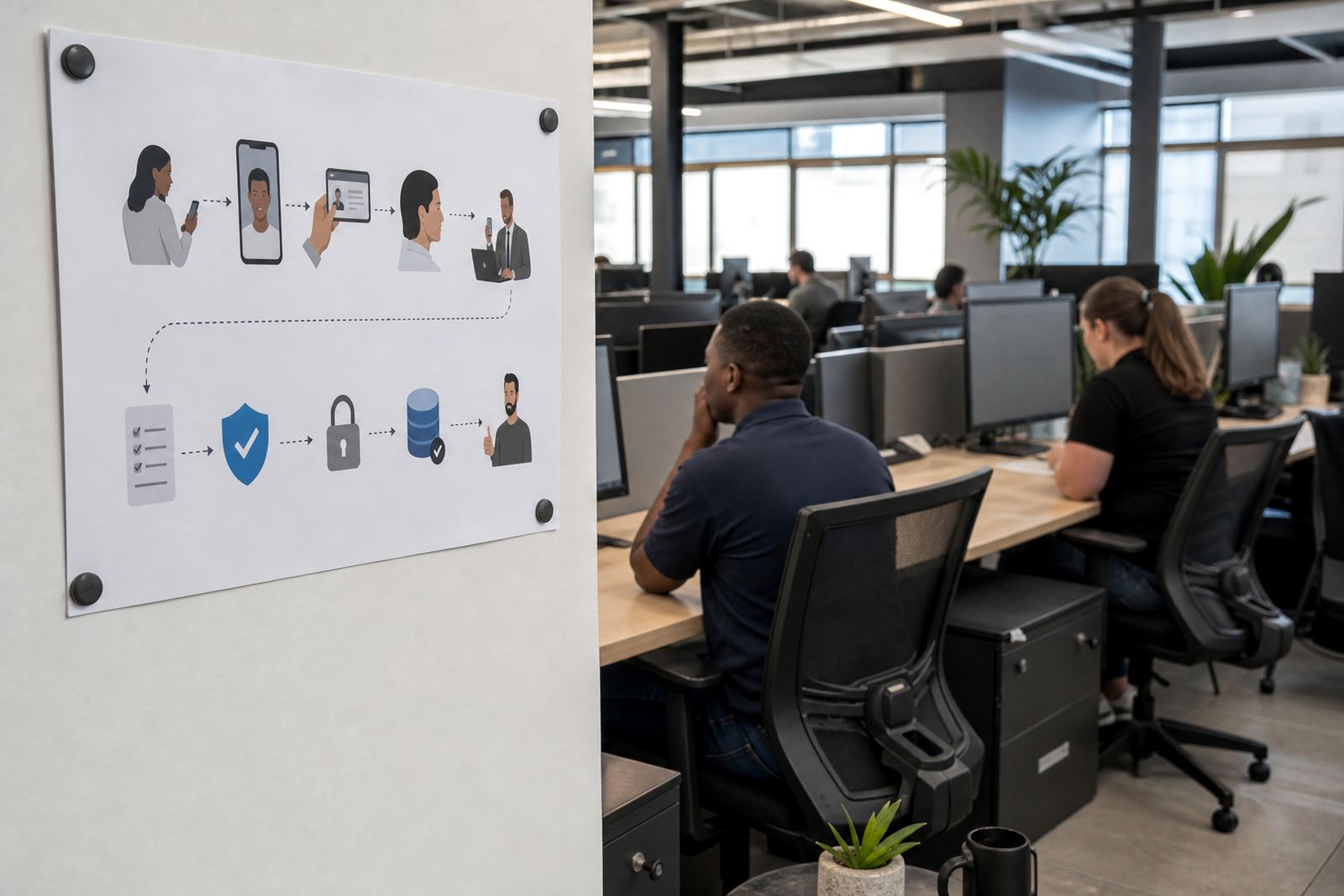
A Pretoria move from paper-heavy intake to guided video checks
The client was a Pretoria insurer handling more new policy applications through online channels, but the identity step was slowing the rest of the file. Their team needed a remote process that could sit inside an existing onboarding flow, keep the conversation live, and give staff a clear record of what was checked during the session.
We mapped the customer journey from application submit to final file review. That meant watching where handovers were breaking, where applicants dropped off, and where the insurer needed more structure around consent, document capture, and note keeping under normal POPIA-aware practice. The brief was not only to verify the person, but to keep the session practical for applicants who were using a phone and a weak data connection.
- Client type: Pretoria-based insurer
- Project focus: online policy application verification
- Session style: short guided video appointment
- Main checks: ID document, face comparison, liveness prompts
What the insurer needed inside the workflow
The insurer wanted less manual follow-up and fewer incomplete verification files. Their operations staff also needed one method they could apply across motor, household and life policy intake, without building a different script for every queue. We kept the design narrow enough for front-line use, but detailed enough for quality review when a case needed a second look.
There were three constraints that shaped the work. First, the process had to work for applicants joining from outside Pretoria. Second, the insurer needed a clear trail of the session, including what was shown and what was confirmed. Third, staff had to learn the hand-off points, because a rushed verification can leave a file looking complete when it is not.
- Online onboarding had to stay short and guided
- Agents needed a shared script for document prompts
- Review notes had to support internal file checks
- The process had to work across multiple product lines
The rollout plan, set across five weeks
We staged the work over five weeks. Week one covered workflow mapping and the practical points where the insurer wanted the video step to appear. Week two focused on integration planning and the fields their team needed captured for case notes and status updates. Week three moved into agent script design and escalation design, so staff would know what to do when a document image was blurred or a face match needed a second review.
Week four was used for staff training and pilot launch support. Week five was for quality monitoring and operational reporting, where we checked session consistency, common applicant questions, and any slip between the script and the live case handling. It was a controlled start, not a wide-open launch, which suited the insurer's team structure.
- Week 1: workflow mapping and intake review
- Week 2: integration planning and API coordination
- Week 3: scripts, escalation paths and QA rules
- Week 4: staff training plus pilot support
- Week 5: reporting, monitoring and stabilising
What we supplied for the Pretoria branch team
The project included integration help, staff training, and a live operating structure that the insurer could use without building a separate support tree. Jared Jantjies handled the integration planning with their technical team, while Anele Nortje worked through session handling and refresh training for staff who needed to lead applicants through the video steps.
We also set out quality monitoring rules for the verification team lead, so unusual cases could be escalated without the session turning messy. The aim was not to overcomplicate the work. It was to give the insurer a repeatable method for identity checks, with enough control to keep records tidy and enough flexibility to deal with real applicants, not perfect ones.
- Workflow mapping for the onboarding sequence
- API coordination for status and case handover
- Agent script design for live sessions
- Escalation design for unclear or incomplete checks
- Refresh training for operational staff
What changed after the first files moved through
Once the pilot cases started flowing, the insurer had a steadier way to handle verification for online applicants. Staff could see the sequence from document presentation to face comparison to final file note, and that made review simpler for the operations team. The process also reduced the back-and-forth that often happens when an applicant is told to repeat a step without clear instructions.
The biggest practical gain was consistency. A guided video session creates a shared rhythm for the applicant and the agent, which helps when the customer is not sitting in front of a branch consultant. It also gave the insurer a cleaner paper trail for internal audits and customer file checks, especially when the case needed extra review before account opening.
- More consistent case handling across staff shifts
- Cleaner records for internal review teams
- Better control over escalation points
- Less drift between script and live session
What we would keep in the next insurer rollout
We would follow the same work order: first map the flow, then refine the scripts, and then train the people who carry the case through to sign-off. That order keeps the technical side tied to the real applicant journey, which matters when policy intake is moving online and the verification step has to sit inside the rest of the admin process.
We would also keep quality monitoring close to the pilot phase. That is where the small issues show up, such as weak camera framing, rushed instructions or a missed escalation cue. Sibusiso Gamieldien handled the quality side on this project, and that discipline helped the insurer settle into a cleaner operating pattern without cluttering the process with extra handovers.
- Map the full customer flow before build decisions
- Train the session team before wider rollout
- Keep quality checks near the pilot window
- Use the same escalation logic across queues
Key facts
| Project | Pretoria insurer rollout for online policy applications |
|---|---|
| Service mix | Workflow Mapping, Integration Planning, API Coordination, Staff Training, Quality Monitoring |
| Location | Rosebank, Johannesburg base serving Pretoria |
| Timeline | 5 weeks from mapping to stabilising |
| Session model | Remote guided video identity verification |
| Client users | Online policy applicants and internal operations staff |